Why We Stopped Selling Grant Applications by the Package
Sep 08, 2026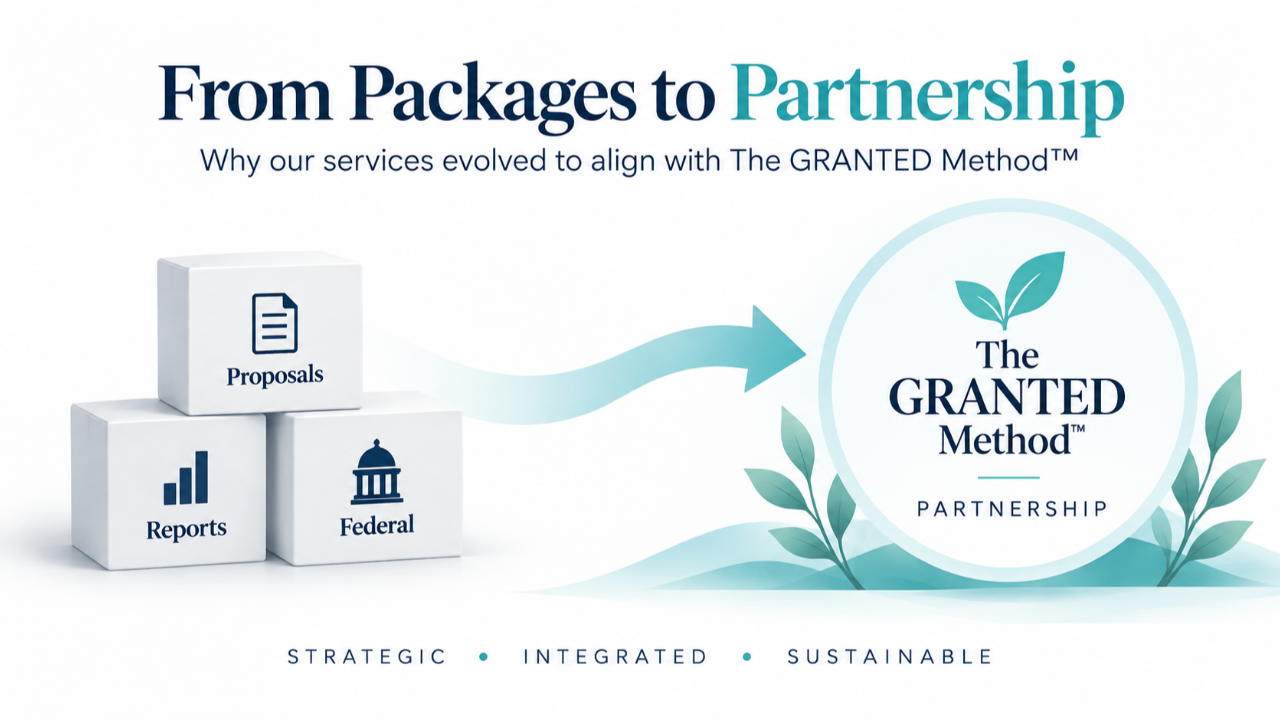
By Laura Chynoweth, CEO of Granted Fundraising Consultants™
“How many grant applications can you write for us?”
It’s a reasonable question to ask a grant consultant. For years, we even made it easy to answer: three, six, nine, or twelve. Pick a proposal package! Need reports? We had packages for those, too. Pursuing a federal grant? We offered a one-time application fee.
The trouble was that the number of documents we could produce didn’t tell us much about what a nonprofit actually needed to accomplish. Twelve applications might sound impressive, but what if only four of those opportunities fit your work? What if you receive all twelve awards and realize you don’t have the staff to deliver everything you promised? (Congratulations! Also: yikes.)
If you’ve read my earlier posts, you know how I feel about measuring grant success by counting applications. Eventually, we had to take a good look at our own service menu and ask whether it reinforced the approach we were encouraging clients to take.
So, we retired our grant proposal packages, grant report packages, and one-time federal grant application fee. Here’s why.
You can’t package your way around preparation.
Imagine buying twelve beautifully wrapped boxes for a birthday party without deciding what goes inside them. You have accomplished the wrapping part. The gift part still needs some attention.
A grant application can present your work beautifully, but the work itself needs to be defined. Who will your program serve? What will participants gain? What will it cost? Who will deliver it, and how will you know whether it worked?
Your grant writer can help you answer and communicate these questions. They cannot make the answers true simply by typing them into an application.
I understand the appeal of buying a finished proposal. Nonprofit leaders already have more than enough on their plates, and removing one task can feel like a small miracle. But you should expect to participate in the planning behind that proposal. You are the expert on your organization, and a strong application needs your expertise.
The GRANTED Method™ makes room for that collaborative work: Ground the Need, Refine the Program, Assemble the Resources, Narrate the Impact, and then Target the Right Funders. Education and development happen throughout.
Notice where finding grants falls in that sequence. There’s a reason for that!
A package shouldn’t determine your funding strategy.
Let’s say you need $100,000 for a well-defined program. Your next task is to identify an appropriate mix of funding opportunities, taking into account eligibility, mission alignment, likely award amounts, relationships, deadlines, and your capacity to manage the funding.
How many applications will that require? It depends.
I know. Everyone’s favorite answer.
But it’s the honest one. Buying six proposals doesn’t make six the right number for your organization. Nor should having an unused proposal in your package become a reason to pursue a grant that doesn’t fit. Your funding goal and the opportunities available should guide the work.
We want to spend time helping you make those decisions, prepare strong materials, and pursue appropriate funders. Sometimes that means writing an application. Sometimes it means improving the budget or advising you to pass on an opportunity before you spend two weeks trying to squeeze your program into it.
That last decision can be valuable, too, even if it produces zero submitted applications.
Reports deserve a place in the plan.
“Our grant report is due Friday. Can you help?”
Of course, a consultant can help prepare a report. But first: Did anyone collect the information it requires?
If you promised to measure changes in participant knowledge, you’ll need a way to measure those changes. If the funder wants an accounting of grant expenditures, someone needs to track them. A compelling participant story is much easier to share when someone has actually captured it and obtained the appropriate permission to use it.
Your report deadline is a terrible time to discover that no one was assigned these tasks.
Reports also give you an opportunity to help a funder understand your progress, discuss challenges, and continue the relationship. They deserve attention throughout the grant period. Selling reports as separate writing assignments didn’t adequately reflect that ongoing work, so we removed the report packages as well.
Federal applications require more than a writer and a deadline.
A federal funding announcement can generate a lot of excitement. A large potential award! A program that sounds like yours! An executive director forwarding the link with “Thoughts?” in the subject line!
Before anyone starts drafting, there are quite a few thoughts worth having.
Does the opportunity fit your program? Are you eligible? Can you meet any match requirements? Do you have the necessary registrations, partners, budget information, and evaluation plan? Can your organization manage the award if you receive it?
A one-time writing fee can make an application sound like a neatly contained assignment. Federal applications often require substantial planning and coordination across the organization, and much of that work needs to happen before the narrative can be completed.
We still want to support this work. We changed how we offer it so the engagement can account for the preparation and collaboration it actually requires.
Yes, we kept the Case for Support.
If you’re wondering why one standalone service survived our service-menu cleanup, here’s the distinction: a Case for Support gives your organization a resource you can continue using across funding opportunities.
It brings together the need your work addresses, your program details, organizational qualifications, evidence, stories, expected outcomes, and funding rationale. You can draw on it when developing applications and other fundraising materials, rather than starting from an empty page every time.
(Please still tailor it to each funder’s questions. You know I am not handing out permission to attach one document to every application and call it a day.)
A strong Case for Support helps your team communicate consistently and work more efficiently. That makes it a good fit for the capacity we want to build with clients.
What should you have when our work together ends?
Hopefully, funding. But you should also have a clearer understanding of your programs, stronger materials, useful systems, and greater confidence deciding which opportunities deserve your time.
You should know where your information lives. You should understand the promises you’ve made to funders. And your funder relationships should belong to your organization.
We can continue to provide expert support as you need it, but we want that support to help your organization grow more capable over time.
That’s why we changed our services. We still write proposals and reports. We still help nonprofits pursue funding. We also make room for the planning, learning, and ongoing work that help those efforts succeed.
Before you ask a consultant how many applications they can write, ask yourself: What would help our organization build a sustainable grants program?
Let’s start there.
